I Never Expected to Teach My Kid This: What to Do If A School Stabbing Incident Happens
Raising a teenager in 2026 is not for the faint-hearted. I have one living under my roof, and I constantly have to decipher her moodiness. As a Malaysian parent, I thought that I'd be able to figure things out as they go along, even in other, more serious scenarios. That thought has changed on what's needed for school safety tips in Malaysia.
I need to prepare my teen to defend herself, especially given the recent stabbing cases in Malaysian schools, which have rocked my core.
What if there's a high-risk student at my teen's school, and what would she do if such an incident happens on her school grounds?
What Parents Can Do as Malaysia Grapples With School Safety Concerns
While the second school stabbing has raised fresh safety concerns, discussions are still ongoing in terms of having best practices in place. Discussions have included the need for more counsellors and teachers that are trained at spotting students who pose a risk.
Others have mentioned that the Education Ministry ought to team up with the Health Ministry to provide ideal psychological support for affected students.
While discussion is ongoing, parents across Malaysia are no doubt thinking about how they can ensure that their child is able to protect themselves should such an incident happen on their own school's home ground.
What to do during a school attack: the order your child needs
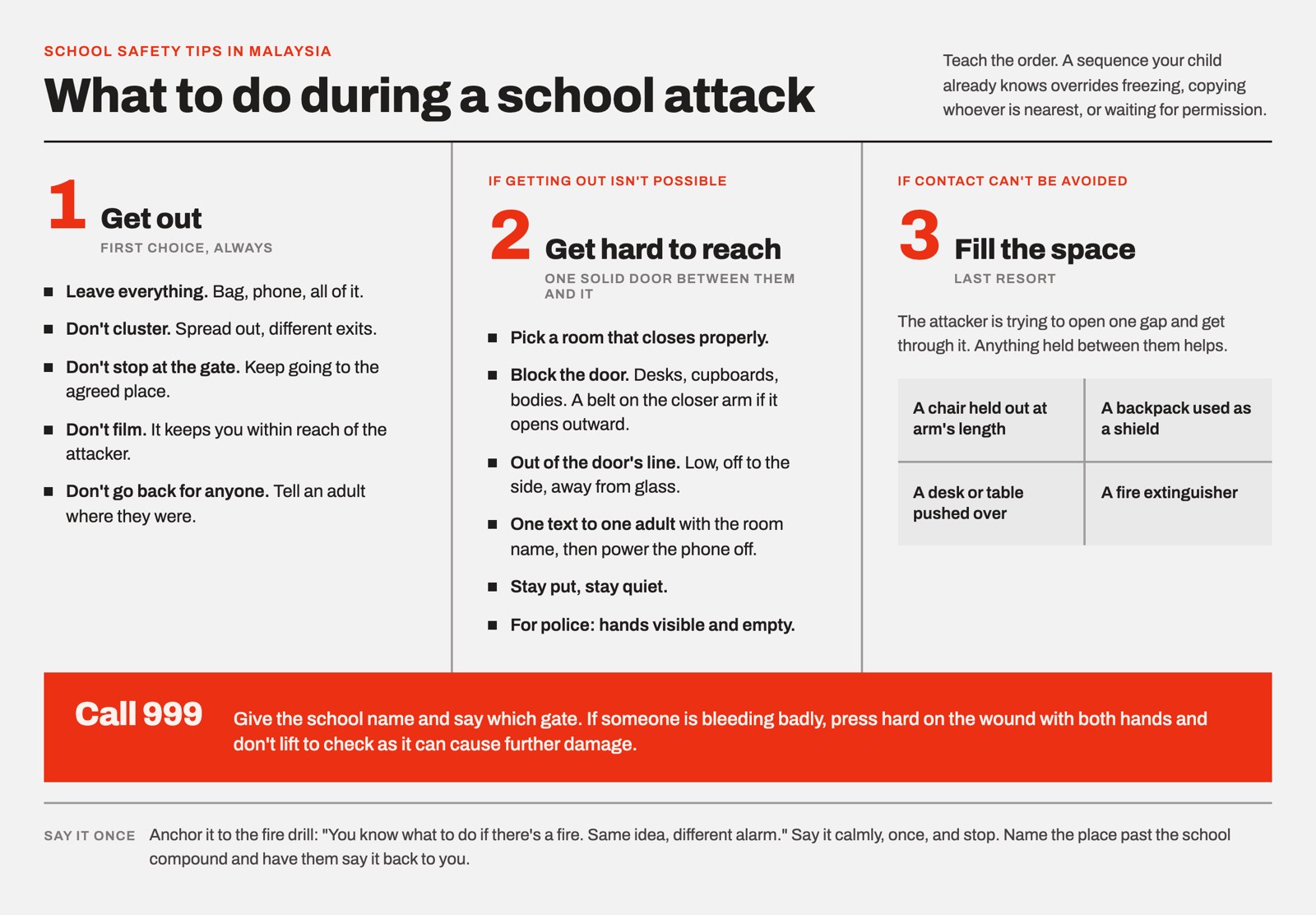
If you teach your child one thing about what to do during a school attack in Malaysia, teach the order in terms of priority.
- Get away, and
- If that isn't possible, make yourself hard to reach.
- If neither works and contact is unavoidable, act.
This order is critical because of what children tend to do under stress. They may freeze. They could copy whoever is standing nearest.
Many will look to a teacher for permission, and the teacher has had no training either.
A sequence your child already knows overrides all of that, helping them to keep harm at arm's length.
Getting out: the single most protective thing your child can do
Most children who get clear of a school attack know what to do before it happens. Here's a list your child could follow:
- Leave everything. Forget the school bag and even the phone if it comes to it. Anything they're carrying is a reason to slow down or turn back. Every second matters.
- Don't cluster. Children bunch around friends or a teacher without thinking about it. Spreading out and using different exits is safer.
- Don't stop at the gate. Name somewhere past the compound. Rush to the next public area near the school and ask for help.
- Don't film. This keeps your child within reach of the perpetrator, which is a no-no.
- Don't go back for anyone. Their job is to get out and tell an adult where their friend was.
Give them a place and make them say it back to you.
School lockdown in Malaysia: what to do when your child can't get out
If ever escape is off the table, your child should aim to have a solid door between themselves and the threat and keep them behind it until police arrive.
Tell them to pick a room that closes properly. Then:
- Block the door. Most Malaysian classroom doors open inward, so desks, cupboards and bodies stacked against them will hold. If a door opens outward, a belt or cable looped around the closer arm buys time.
- Get out of the door's line. Away from the doorway and any glass panel, low and off to the side.
- Turn the phone off. Silent isn't enough. Vibrate carries in a quiet room. Send one text to one adult with the room name, then power it down.
- Stay put and stay quiet. After a few minutes of silence, the urge to look out gets strong, and that's when children get hurt.
- Follow police instructions with hands visible and empty.
The last resort
If your child is cornered and contact can't be avoided, what the attacker would be trying to do is open up one gap and get through it. Anything that fills the space between the attacker and your child helps:
- A chair held out at arm's length
- A backpack used as a shield
- A desk or table pushed over
- A fire extinguisher
How to stop severe bleeding
Blood loss kills on a clock that's often faster than an ambulance can travel, and hard direct pressure from whoever is standing there in the first few minutes is what changes the outcome. Ten minutes is enough to teach it.
- Push hard, right on the wound, using the heel of the hand or both hands stacked. Harder than feels reasonable.
- Use whatever's to hand to stop the bleeding, like a piece of cloth.
- Don't lift to check. If the cloth soaks through, add more on top.
- Don't pull out anything embedded in the wound. Press around it.
- Keep pressing until someone with proper equipment takes over.
- Call 999. Give the school name and say which gate.
Teach it as ordinary first aid, as this makes it easier for your teenager to take in.
How to teach a child an emergency plan without frightening them
How you say this matters more than what you say. What makes children anxious is repetition and intensity, not information. Said once, calmly, it registers as a procedure. Said over and over, or said while you're visibly scared, it registers as a threat.
- Anchor it to the fire drill. "You know what to do if there's a fire. Same idea, different alarm."
- Do it once and stop.
- Play the exit game. At the mall, at pickup, anywhere. "If we had to leave right now, which way?"
- Answer questions straight. Children read vagueness as something being hidden from them.
- Watch your own tone. They take their cue from you.
Self-defence classes for kids in Malaysia: what to look for
Self-defence training will not let a child beat an armed attacker, and any parent who enrols a child expecting that is setting them up badly.
What it does deliver is worth having anyway: better awareness of surroundings, a body that reacts instead of freezing, the confidence to walk away from a confrontation, and a habit of speaking up.
Those are the things that matter in the ordinary bullying and intimidation your child is far more likely to face.
Options available across Malaysia
- Your child's own school. Silat and taekwondo run as co-curricular clubs in most national secondary schools at no extra cost. Start here before paying for anything.
- Taekwondo. The most widely available paid option. YMCA Kuala Lumpur, for example, runs classes. State associations and clubs such as AMAAL run classes across the Klang Valley, Johor and Kedah, and ATSA operates several branches in Kota Kinabalu.
- Brazilian jiu-jitsu, boxing and Muay Thai. Structured short courses.
What to check before you pay
- Ask what the instructor teaches about weapons.
- Ask whether de-escalation and reporting are taught, not just physical technique.
- Sit in on a class. Look at whether the coach corrects children calmly and whether the kids look comfortable.
- Check the instructor's affiliation. Taekwondo clubs should be registered with the national federation, silat schools with PESAKA or a recognised perguruan.
- Compare local rates. Community and school-based classes run cheaper, while commercial academies in KL can charge considerably more for the same core skills.
Two Stabbing Cases in Malaysian Schools, 10 Months Apart
As much as it makes me shudder to recap these incidents here, I feel more for the parents involved (both victims and perpetrators).
In October 2025, 16-year-old Yap Shing Xuen was fatally stabbed in a toilet at SMK Bandar Utama Damansara (4) in Petaling Jaya. The boy accused of killing her was 14 at the time and cannot be named because he is a minor.
His murder trial began in August 2026. His lawyer has argued he suffers from a mental disorder that was detected after the pandemic and worsened without adequate early treatment.
Ten months later, in July 2026, a 15-year-old girl at SMK Bandar Banting in Kuala Langat was stabbed by a fellow 15-year-old and seriously injured. The accused had been out of school for eight months and was charged on 10 July under Section 307 of the Penal Code for attempted murder.
Selangor police chief Datuk Shazeli Kahar told reporters that initial investigations had ruled out bullying, and pointed to severe stress among the contributing factors.
Both cases are before the courts, so much is still unestablished. What is already clear is that in each one, a child in visible difficulty was known to the adults around them well before anything happened.
Where This Leaves Us as Parents
Both cases involved a child struggling long before the incident, and as parents, we always want to ensure our child is prepared, even for the worst scenarios.
Ask your teen from time to time if there's anyone at school who seems to be having a hard time, and listen for any information that stands out when they answer.
If it's your own child who's pulling away, reach out early, even when it feels like an overreaction.
Preparing our children for the worst matters, but so does noticing when one of them is quietly heading there.
Photo: Vitaly Gariev / Unsplash.
← Back to all posts